Awareness & Policy

Privacy in Vehicles

Modern vehicles are rolling computers. SHIELD studies what data they collect, where it goes, and how drivers — and everyone around them — can stay in control.

OPC Contributions Program · 2025–26

Driving Privacy Forward

Homomorphic Encryption and Oblivious AI in Smart Mobility. Supported by the Office of the Privacy Commissioner of Canada, this project asked a simple question: can connected-vehicle analytics stay useful without service providers routinely seeing raw personal data?

Through a technical demonstration and two rounds of stakeholder interviews, SHIELD showed that privacy-preserving analytics can improve both the intelligibility and the perceived legitimacy of connected-vehicle data use — while making the case that governance matters as much as the technology.

Read the policy brief →
The core finding

Over-collection — not data scarcity — is the central privacy problem.

Data can move across manufacturers, telematics providers, insurers, apps, analytics platforms, cloud processors, and dealerships. Risk arises from over-collection, unclear downstream use, and routine exposure of raw data during processing.

What We Found

Key findings

Over-collection is the core problem

Stakeholders repeatedly described excessive data collection — not data scarcity — as the central privacy concern in connected mobility.

Useful analytics, less raw exposure

Our demonstration showed cloud-based mobility analytics can still deliver useful results without the service provider routinely seeing raw personal data.

Governance matters as much as technology

Encryption alone is not enough. Trust depends on data minimization, clear roles, auditability, meaningful transparency, and limits on reuse.

Privacy extends beyond the driver

Connected-mobility governance should also account for passengers, pedestrians, cyclists, and others captured indirectly in public space.

Policy

What we recommend

Priorities for PIPEDA modernization, CPPA-style reform, and Transport Canada’s connected-mobility context.

1

Recognize mobility data as potentially high-sensitivity in law and binding guidance.

2

Require privacy impact assessments before high-risk connected-vehicle processing.

3

Strengthen purpose limitation and restrict function creep and repurposing.

4

Create a practical mobility-data transfer (portability) right for individuals.

5

Recognize privacy-enhancing technologies as valid ways to reduce exposure.

6

Clarify de-identification, anonymization, and residual inference risk.

7

Require layered, just-in-time transparency at the vehicle and app interface.

8

Require accountable, proportionate governance across the whole data ecosystem.

Public Awareness

Privacy Awareness Week

A plain-language campaign helping drivers understand vehicle data — part of our knowledge-transfer mandate.
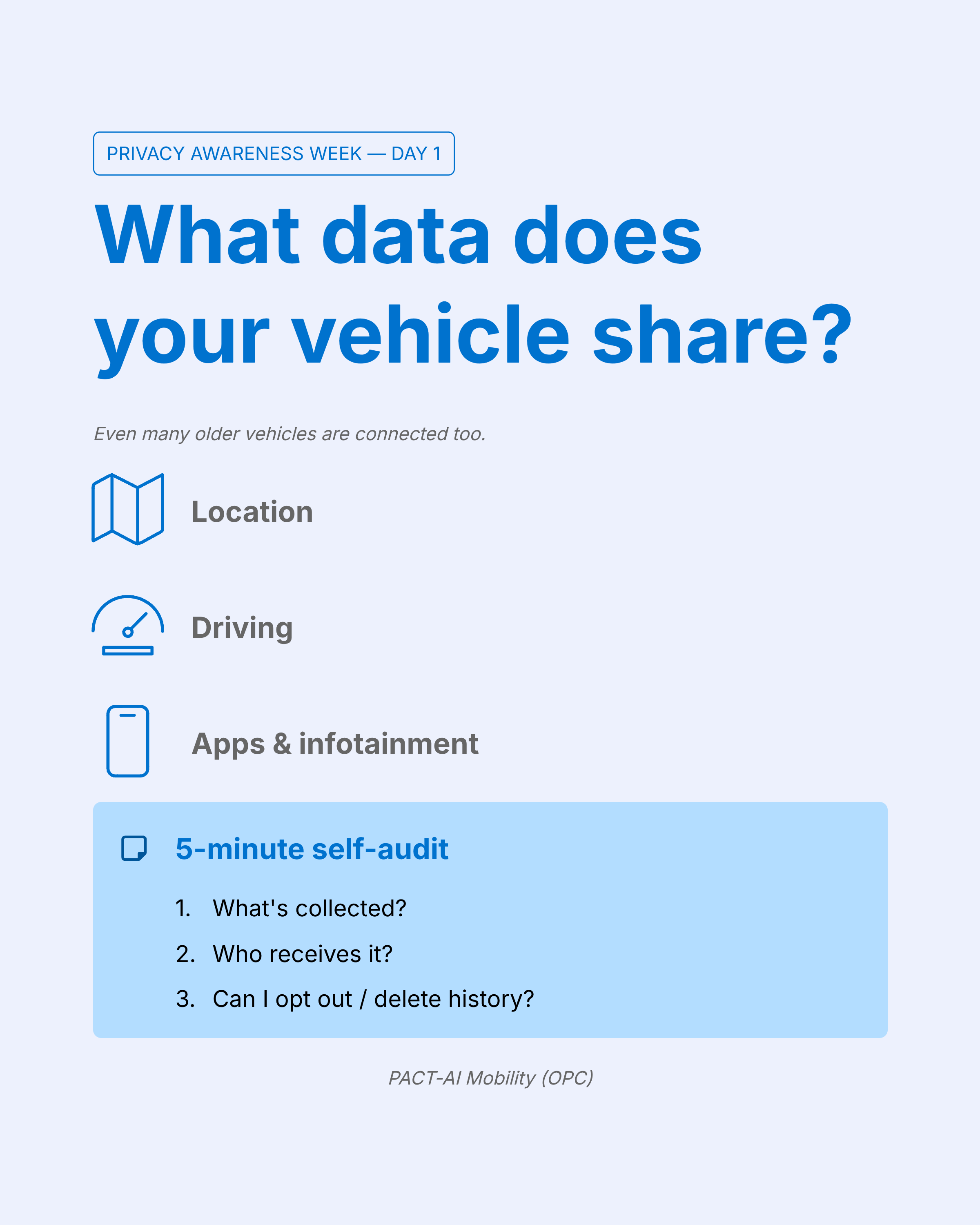
Privacy Awareness Week Day 1
Day 1 · What data does your vehicle share?
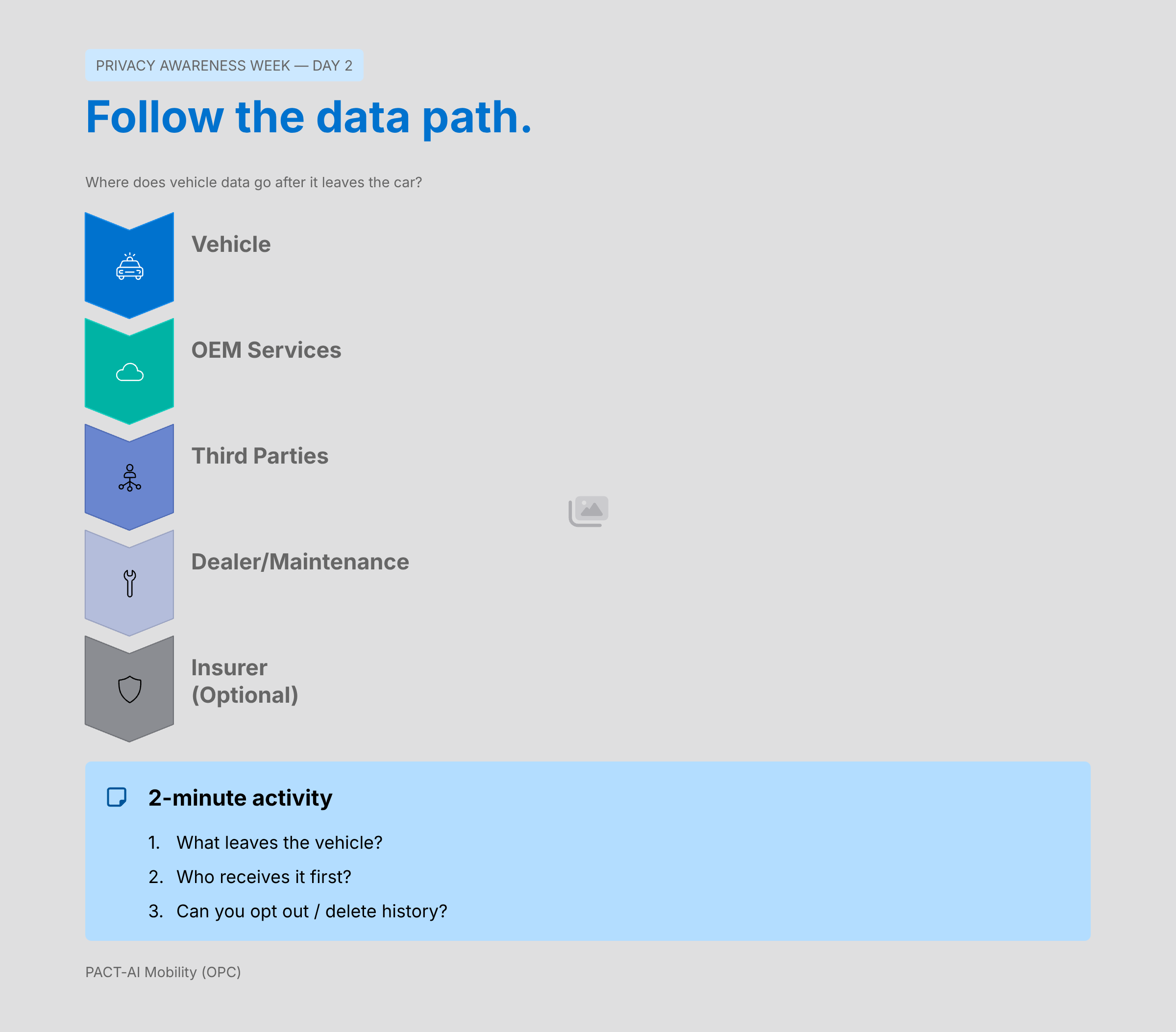
Privacy Awareness Week Day 2
Day 2 · Follow the data path
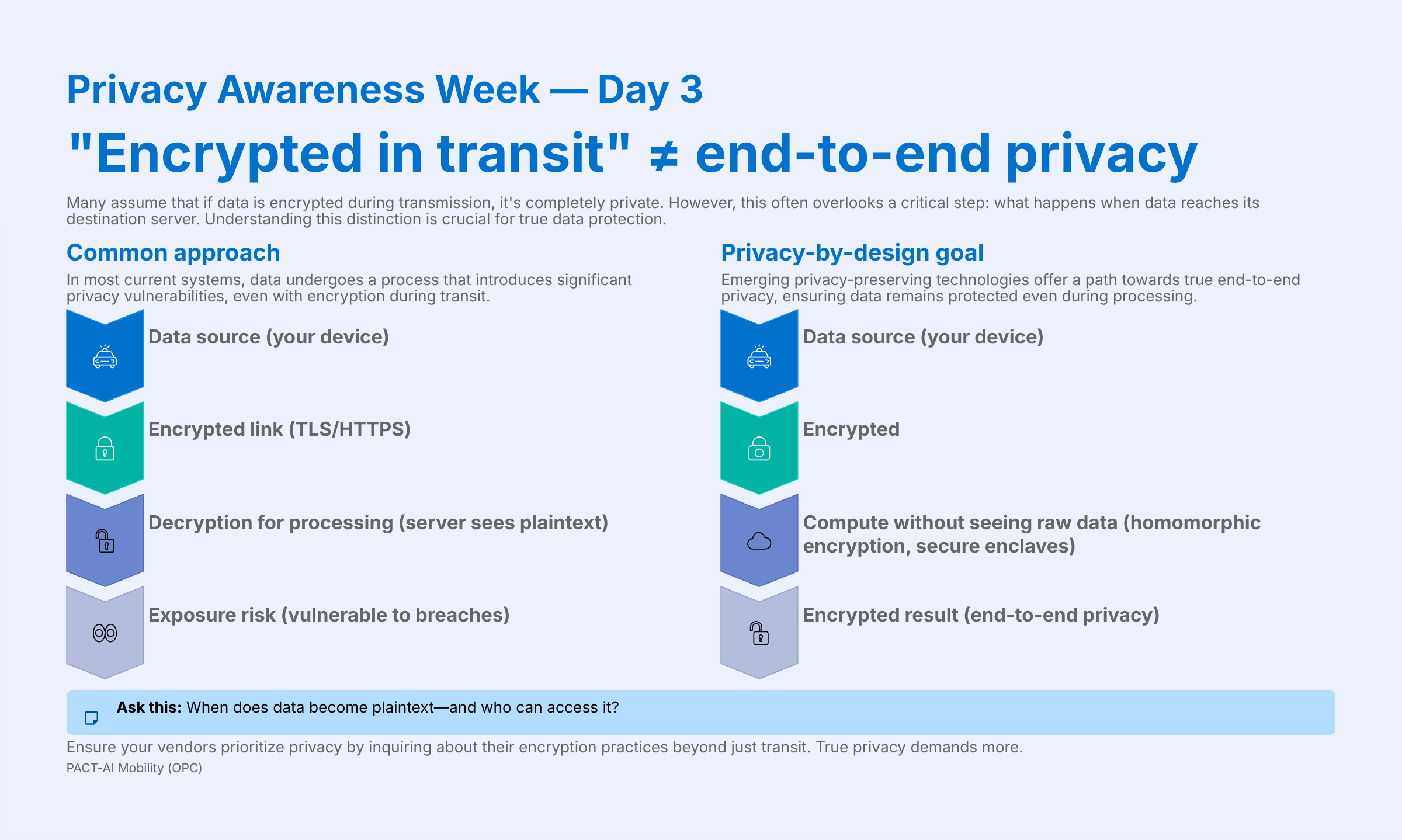
Privacy Awareness Week Day 3
Day 3 · “Encrypted in transit” ≠ end-to-end privacy
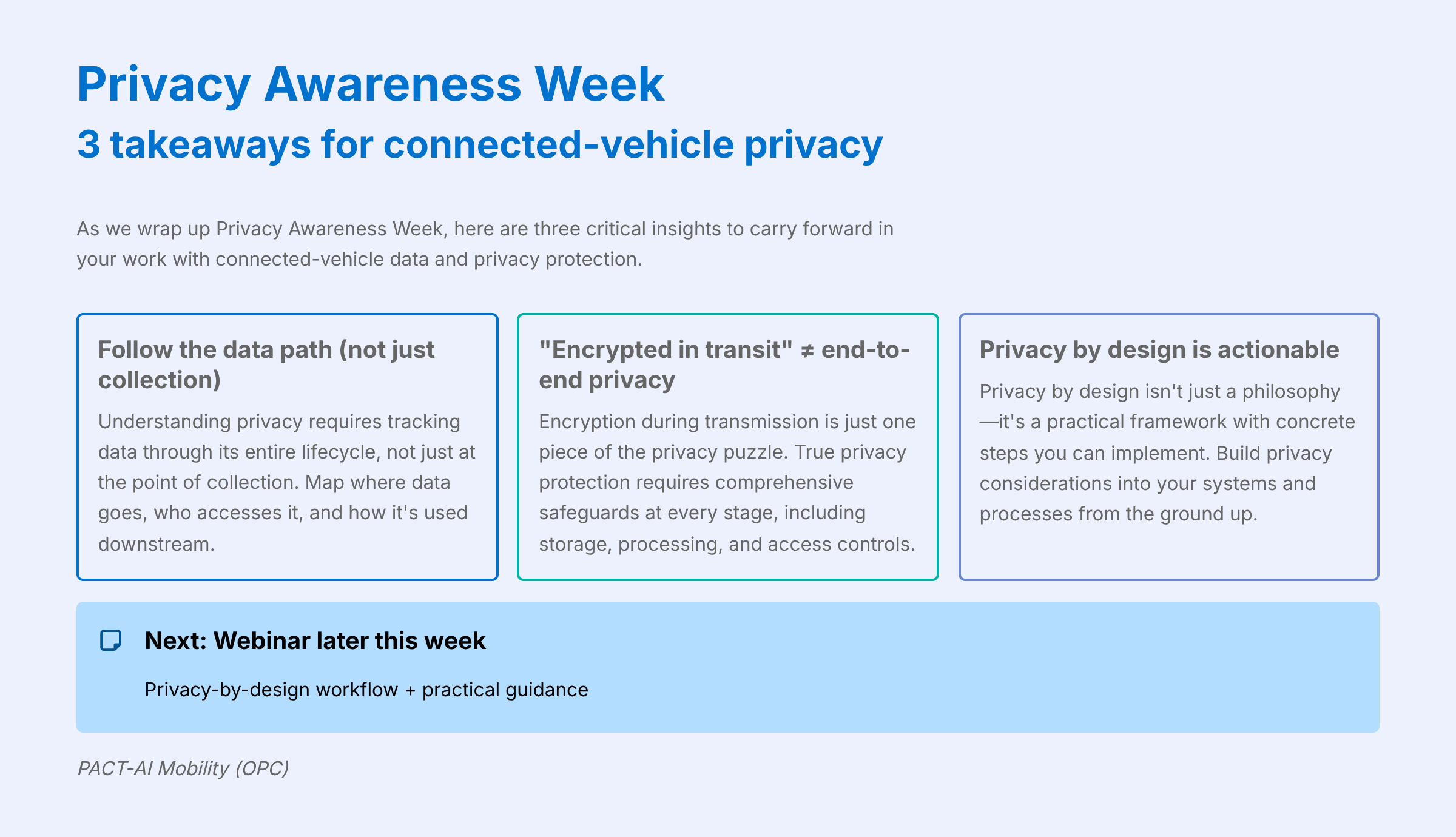
Privacy Awareness Week Closing
Closing · Three takeaways for connected-vehicle privacy
Webinar

Privacy Awareness Week conversation

To close out Privacy Awareness Week 2026, Dr. Mitra Mirhassani spoke with Dr. Ikjot Saini about what today’s vehicles collect, where that data can go, and what “privacy by design” can look like in practice.

26 min 38 s Dr. Mitra Mirhassani & Dr. Ikjot Saini · Download recording (170 MB)
Open Access

Project outputs

The completed project and its knowledge-translation materials, published for public access.

Final Research Report

Available

The comprehensive close-out report synthesizing the technical, qualitative, and outreach work of the project.

Download PDF →

Policy Brief

Available

A plain-language translation of the technical findings into regulatory recommendations for PIPEDA / CPPA modernization and Transport Canada’s CAV Safety Framework.

Download PDF →

Privacy Awareness Week Materials

Available

Public-education cards explaining what connected vehicles collect, where the data goes, and how to stay in control.

View the campaign →

Privacy Awareness Week Webinar

Available

A closing conversation with Dr. Ikjot Saini on what today’s vehicles collect, where that data can go, and what “privacy by design” looks like in practice.

Watch the recording →

Webinar Slide Deck

Available

The companion slide material: the prototype walkthrough, connected-vehicle privacy risks, and the best-practice guidance presented during Privacy Awareness Week 2026.

Download PDF →

Benchmark Data Package

To be posted

An anonymized bundle of encrypted logs, traces, and scripts enabling other researchers and regulators to reproduce the latency and accuracy results.

Funding acknowledgement. This project has been funded by the Office of the Privacy Commissioner of Canada (OPC); the views expressed herein are those of the author(s) and do not necessarily reflect those of the OPC.
Stay in control

Privacy is part of trustworthy mobility

Public trust in connected and automated vehicles depends not only on safety and cybersecurity, but on credible privacy governance across the full data lifecycle.